What you need to know now about koi pond cost:
- A professionally installed koi pond typically costs between $5,100 and $15,900, with most homeowners spending around $10,500 for a complete build.
- Size drives most of the price difference. A small starter pond and a large estate-style pond can differ by tens of thousands of dollars.
- Ongoing costs matter as much as the build itself. Electricity, fish food, and water treatments typically run $1,000 to $2,000 a year for the life of the pond.
- Colorado’s water law can affect whether and how you’re allowed to fill and maintain a pond, a detail almost no national pond guide mentions.
Keep reading for the full breakdown by size, component, and what Colorado Springs adds to the number a national average won’t show you.
Costs mentioned throughout this article are general estimates, not a quote. Pricing varies by site access, soil conditions, design complexity, and material choices, so use these figures to frame your budget thinking, then get a real number from a contractor who has seen your yard.
How Much Does a Koi Pond Cost?
A professionally installed koi pond typically costs between $5,100 and $15,900, with most homeowners landing around $10,500 for a complete build. That range covers excavation, liner, filtration, basic rock and plant edging, and a modest starter group of fish.
What Pushes a Project to Either End of That Range
- Size and depth: More water volume means more excavation, more liner material, and a larger filtration system to keep it clear.
- Design complexity: A simple kidney-shaped pond costs far less than one with waterfalls, streams, lighting, and multiple viewing areas.
- Fish selection: Standard koi run affordable, while rare or imported varieties can push the livestock cost alone into four figures.
- Site access: A backyard that’s hard for equipment to reach adds labor cost regardless of the pond’s final size.
We’ve built koi ponds across Colorado Springs ranging from simple patio-adjacent features to full estate installations with waterfalls and stream beds, and size is almost always the single biggest factor separating a $6,000 project from a $30,000 one.
How Does Pond Size Change the Total Cost?
Pond cost scales with water volume, but not in a straight line. A large pond costs more per gallon in fish and filtration, yet often costs less per square foot in liner material once you account for the fixed costs every pond shares.
Cost by Pond Size
| Pond Size | Approximate Volume | Estimated Cost Range |
|---|---|---|
| Small (6×8 ft) | 500 to 1,000 gallons | $3,000 to $8,000 for a custom design |
| Medium (11×16 ft) | 2,000 to 3,000 gallons | $7,000 to $12,000 standard, up to $35,000 custom |
| Large (16×20 ft and up) | 4,000 to 8,000 gallons | $15,000 to $25,000 basic, $45,000 or more for complex estate features |
Why Volume Matters More Than Surface Area
- A deeper pond holds more water per square foot of surface, which is what actually protects koi through a Colorado winter, not just how wide the pond looks from above.
- Filtration systems are sized to total gallons, not footprint, so a compact but deep pond may need the same filtration as a shallow pond twice its visible size.
- Pump sizing follows the same rule. Undersizing a pump to save money on a larger pond is one of the most common mistakes that leads to cloudy water and stressed fish.
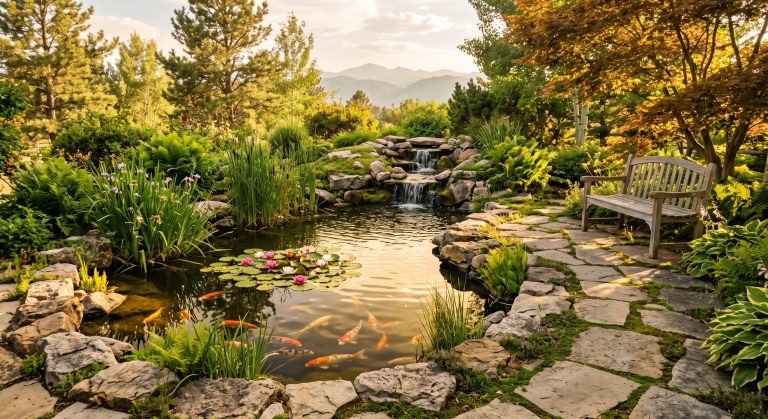
Curious what different pond sizes actually look like finished? Browse real koi pond and water feature projects around Colorado Springs. See our project gallery →
What Goes Into the Cost Beyond the Hole in the Ground?

Excavation and liner are just the starting point. Filtration, pumps, and the fish themselves often add up to as much as the hole and liner combined, which is why two ponds of similar size can carry very different price tags.
Component Cost Breakdown
| Component | Typical Cost Range | Notes |
|---|---|---|
| Excavation | $60 to $200 per cubic yard | Rocky or clay-heavy soil pushes this toward the high end |
| Pond liner | $0.30 to $2 per square foot for EPDM or HDPE material alone, before underlayment, seaming, and labor; installed liner systems typically run higher than the material cost implies. Poured concrete runs up to $114 per square foot fully installed | Flexible liners dominate residential installs; concrete is reserved for premium builds |
| Filtration system | $150 to $1,300 | Scales with pond volume and fish load, not just surface area |
| Water pump | $50 to $2,000 | Energy-efficient models cost more upfront but lower the yearly electricity line item |
| Starter koi | $15 to $55 each for standard varieties | Rare or imported koi can run several hundred dollars per fish |
| Permits | $150 to $485 | Varies by jurisdiction and whether electrical work is involved |
Where Homeowners Usually Underbudget
- Filtration sized for growth: Koi grow quickly, and a filtration system sized for today’s small fish often falls short within a year or two.
- Electrical runs: Getting power to a pump and any lighting sometimes means trenching a new circuit, a cost that’s easy to overlook when budgeting from the pond itself.
- Edging and hardscape: Natural stone, flagstone, or paver edging around the pond is frequently priced separately from the water feature itself.
How Much Does It Cost to Keep a Koi Pond Running Each Year?

Most koi ponds cost $1,000 to $2,000 a year to maintain, covering electricity for the pump and filter, fish food, water treatments, and periodic filter media replacement. That ongoing number matters as much as the upfront build cost over the life of the pond.
Where the Annual Budget Goes
- Electricity: Pumps and filters run continuously, and this is usually the single largest line item in yearly upkeep.
- Fish food: Koi eat seasonally, with feeding scaling up in warm months and dropping off as water temperatures fall.
- Water treatments: Dechlorinators, beneficial bacteria, and algae control products add a modest but recurring cost.
- Filter media and replacement parts: Mechanical filter pads and UV bulbs wear out and need periodic replacement to keep the system working as designed.
Why Colorado’s Climate Adds to This Number
Freeze and thaw cycles put extra strain on pumps and plumbing that stay in the ground year-round, and dry Front Range winters increase evaporation even when a pond is otherwise dormant. Budgeting a little above the national maintenance average is realistic for a pond that runs through a full Colorado Springs winter rather than shutting down completely.
Thinking about how a water feature fits into a water-conscious landscape? We’ve written about balancing water use with a beautiful yard. Read our guide to xeriscaping in Colorado →
Does Colorado Water Law Affect Your Pond?
Colorado treats water differently than most states, and that can affect a koi pond depending on how it’s filled and where it sits. A pond filled from your municipal tap is rarely an issue, but a pond filled from a private well or one that intercepts natural drainage can run into real legal requirements.
What Actually Triggers a Water Rights Question
- If you plan to fill or top off your pond using a private well rather than municipal water, Colorado law may require an augmentation plan before a well permit is issued, according to the Colorado Division of Water Resources. Small exempt wells serving a single household under specific pumping limits follow different rules, so the requirement isn’t universal for every well.
- Ponds that expose groundwater or capture natural surface flow are treated differently than a lined, self-contained backyard feature filled from a garden hose.
- Parts of El Paso County, particularly the area around Ellicott and Peyton within the Upper Black Squirrel Creek Designated Ground Water Basin, have been under active review by state water officials for unpermitted ponds, according to the Colorado Division of Water Resources.
What This Means for a Typical Backyard Koi Pond
Most residential koi ponds built and filled with municipal water, with no connection to a natural stream, ditch, or groundwater seep, don’t trigger these requirements. The distinction matters most for larger properties, rural parcels, or anyone considering a well as a water source, situations more common on the edges of El Paso County than inside city limits.
What Permits and Utility Work Does a Koi Pond Need in Colorado Springs?

A small, shallow ornamental pond may not need its own building permit, but that exemption shrinks fast once depth, volume, or a raised wall structure start to resemble what the Pikes Peak Regional Building Department treats as a pool, and the electrical work that powers a pond’s pump and lighting almost always needs a permit regardless of the pond itself. Assuming a pond is automatically permit-exempt is a common and avoidable mistake.
What Typically Requires Sign-Off
- Pikes Peak Regional Building Department code explicitly lists “Pool” as requiring a building permit, and a pond built deep enough or with pool-like safety features can fall under that same category depending on design.
- Electrical work is always a permitted category under PPRBD, which covers the wiring and outlets a pond pump and any lighting depend on, whether or not the pond itself needs a separate permit.
- GFCI protection on any outdoor electrical circuit near standing water is required by code in most jurisdictions, and it’s the one safety detail worth never cutting corners on.
Why This Step Gets Skipped
Homeowners often think of a pond as a landscaping feature rather than a structure with a real electrical load, so the permit conversation never comes up until an inspector or a future buyer’s home inspection flags unpermitted wiring. Handling this upfront avoids both the safety risk and the paperwork headache later.
Planning a water feature as part of a larger yard redesign? See how a pond fits into a full outdoor living plan. Explore our landscaping and outdoor living services →
What Should You Ask a Pond Builder Before You Sign?
The right pond builder plans for filtration capacity and electrical needs before you ever pick a shape or a rock style, since those decisions determine whether the pond stays healthy for years rather than months. A contractor who leads with aesthetics before asking about fish load and winter care is skipping the part that actually matters.
Questions Worth Asking
- Do they size filtration and pumps for the pond’s mature fish load, or just for what you’re stocking on day one?
- Who handles the electrical permit for the pump and any lighting, and is that included in the quote?
- What’s their plan for winterizing the pond so pumps and plumbing survive a Colorado freeze?
- Can they show real, finished ponds they’ve built locally, not just renderings or catalog photos?
Want to see how a water feature could work in a smaller yard? We’ve covered exactly these layout tradeoffs. Read our guide to landscaping ideas for small yards →
Frequently Asked Questions about Koi Pond Cost
How much would it cost to build a 5,000 gallon koi pond?
A 5,000 gallon pond sits between the medium and large size categories, so expect somewhere in the range of $15,000 to $25,000 for a professionally built pond with standard filtration and modest edging. Custom designs with waterfalls, extensive stonework, or premium filtration can push well past that range.
How much does a 1,000 gallon pond cost?
A 1,000 gallon pond falls at the top of the small size category, typically running $3,000 to $8,000 for a straightforward professional build. Adding custom features like a waterfall, upgraded stone edging, or premium filtration can push a pond this size toward $10,000 to $12,000.
How many fish can I have in a 5,000 liter koi pond?
As a conservative guideline, plan on roughly one inch of adult koi length per 10 gallons of water, which works out to a modest handful of full-grown koi in a pond this size, not dozens. Overstocking is one of the most common causes of poor water quality and stressed fish, so it’s worth planning stocking density around your filtration capacity rather than how many fish look appealing in the store.
Is it hard to keep koi fish alive?
Koi are relatively hardy fish, but most losses trace back to water quality problems rather than the fish themselves being fragile. Proper filtration sized for your fish load, regular water testing, and a real winterization plan prevent the majority of issues homeowners run into.
Can a koi pond survive a Colorado winter without being drained?
Yes, as long as the pond has enough depth and a functioning de-icer or aerator to keep an opening in the ice for gas exchange. A pond that’s too shallow for our winters, generally under 18 to 24 inches at its deepest point, puts fish at much higher risk during a hard freeze.
Do I need to test my pond water regularly?
Yes, especially in the first year while the biological filtration system is still establishing itself. Regular testing for ammonia, nitrite, and pH catches problems early, before they show up as stressed or dying fish.
Your Pond, Sized and Built for Colorado Springs
A koi pond is one of the more rewarding features you can add to a yard, but it’s also one of the easiest to underbudget if filtration, electrical work, and winter care get treated as afterthoughts.
Genesis Group has built water features across Colorado Springs that account for our elevation, our winters, and the fish load each pond actually needs to support long term, not just what looks good on installation day.
Ready to talk through what a koi pond would take in your yard? Contact Genesis Group to get started.